
The Multi-Functional Living Reality
Urban family life often unfolds across limited square footage. In a one- or two-bedroom apartment, living spaces constantly shift roles: a corner of the primary bedroom serves as a temporary nursery, the living room doubles as an evening workspace, and a hallway nook might host a compact bassinet. While traditional parenting literature frequently assumes a dedicated nursery down the hall, modern city dwellers navigate a different set of logistical boundaries. When daily tasks such as preparing meals, running laundry, or handling remote work occur just a few paces from where an infant rests, managing infant sleep requires practical balance rather than expansive infrastructure.
The Proximity Paradox in Compact Homes
Intuitively, living in a smaller residence might suggest that keeping track of an infant is straightforward. In practice, compact quarters create a distinct challenge often described by pediatric researchers as a proximity paradox. Thin partition walls, creaky floorboards, and shared ambient noise mean that physical presence can easily disrupt light sleep cycles. Tiptoeing across the room to check on a slight murmur frequently results in an unintentional waking. At the same time, background sounds from kitchen appliances or street traffic can mask genuine distress calls. The American Academy of Pediatrics recommends room-sharing without bed-sharing for at least the infant’s first six months to support safe sleep. However, navigating this close-range setup requires methods that allow caregivers to verify comfort without physically intruding into the sleep zone.
Establishing a Flexible Daytime Workflow
Infant sleep patterns during early development are fragmented, often requiring modular sleep stations. A baby may nap in a pack-and-play near the dining area in the morning and relocate to a bassinet in the bedroom by afternoon. Rather than cluttering every room with dedicated hardware, caregivers increasingly adopt a mobile approach. Designing a sensible daytime monitor setup involves selecting lightweight, transportable gear that transitions between rooms without requiring structural mounting or complex network reconfigurations. Maintaining visual and audio contact across flexible zones enables parents to continue their daily routines without turning every square foot of an apartment into baby-centric storage.
Safety Standards and Spatial Placement
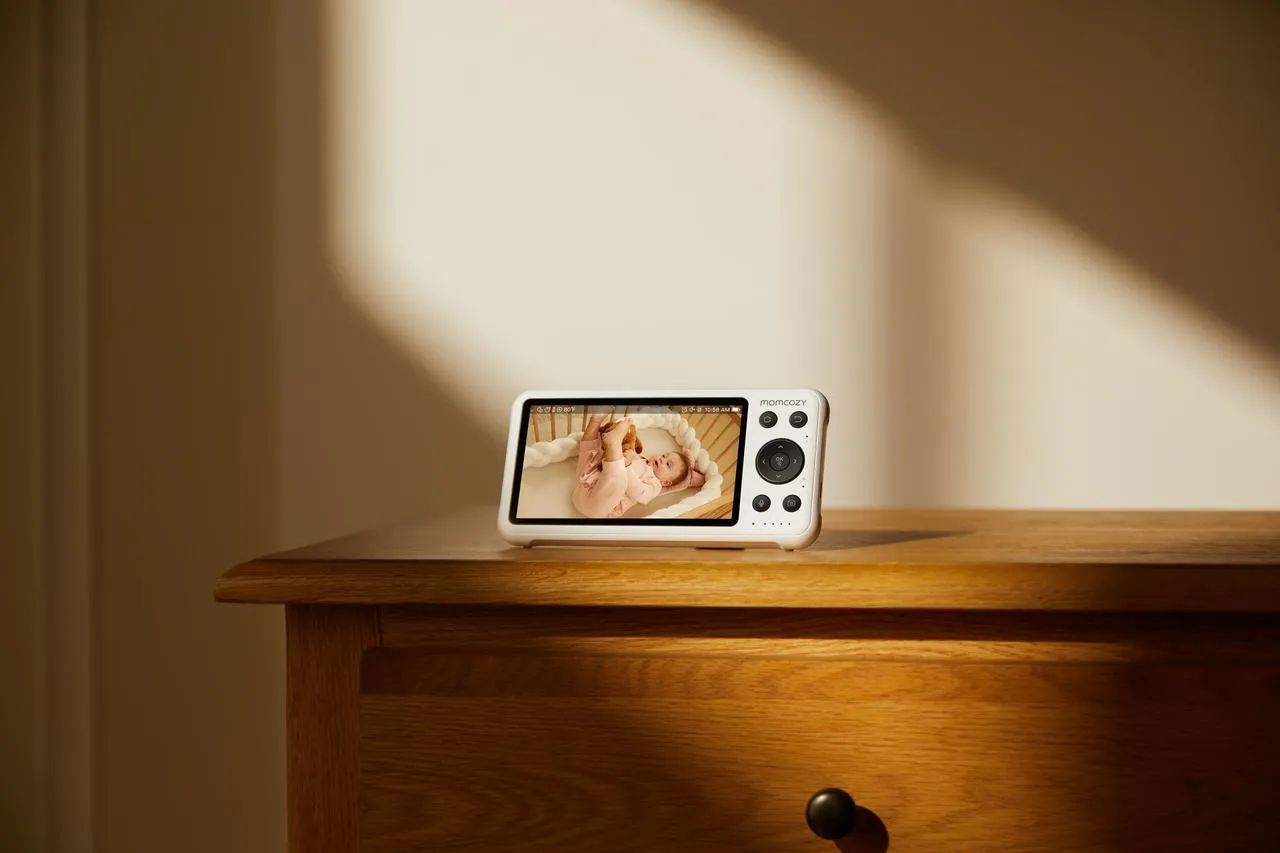
Installing electronic devices in tight spaces demands strict adherence to juvenile safety standards. According to safety guidelines from the U.S. Consumer Product Safety Commission (CPSC), monitor cords present a strangulation hazard if positioned within an infant’s reach; cords must always remain at least three feet away from any edge of a crib or bassinet. Achieving optimal monitor positioning in a small room often means utilizing existing elevated furniture—such as a sturdy bookshelf or high dresser—rather than drilling into walls, which many rental agreements prohibit. The objective is to secure a wide viewing angle of the sleep surface while keeping all wires, adaptors, and hardware completely inaccessible to curious hands.
Evaluating Technical Trade-Offs in Dense Living
Selecting the best baby monitor for small apartments comes down to navigating density and interference. Multi-unit apartment buildings are saturated with Wi-Fi signals, smart home hubs, and wireless appliances, which can cause network congestion or signal dropouts. Traditional radio-frequency units offer stable, private feeds without bandwidth strain, yet they lack the flexibility needed when a parent steps out to the building’s basement laundry room or collects mail from the lobby. Conversely, purely app-based Wi-Fi cameras rely entirely on internet stability and drain smartphone batteries during extended daytime work sessions. A balanced technical architecture addresses both conditions by providing dedicated local reception alongside secure remote access.
Dual-Mode Architecture in Practice
Hardware design has begun addressing these spatial realities through dual-transmission systems. As an illustrative example, Momcozy 5-Inch Dual-Mode Smart Baby Monitor (BM04), which bridges this gap by pairing a dedicated 5-inch parent unit with mobile application connectivity. In everyday urban use, the standalone parent unit provides a closed-loop local screen that sits conveniently on a kitchen counter or work desk, operating independently of household Wi-Fi to support responsive monitoring without relying on an internet connection. Meanwhile, the accompanying smartphone Momcozy app enables remote viewing when a parent steps out to common residential areas or handles tasks across different floors. The device also incorporates motion detection notifications to alert parents when movement is detected in the monitored area and offers multi-camera pairing for homes where nap spaces alternate between different rooms. This dual-track approach reflects a broader engineering shift toward low-friction oversight that adapts to non-traditional layouts without over-complicating the sleep environment.
Preserving the Balance Between Oversight and Rest
Technological tools are most effective when they reduce parental anxiety rather than intensify it. In tight living environments where adults and children share close quarters, constant screen-checking can become an accidental distraction. Pediatric sleep specialists frequently emphasize the value of allowing infants to develop self-soothing behaviors during brief, non-distressed awakenings. A visual monitor functions best not as a continuous focal point, but as an objective verification tool—providing quick reassurance before an adult decides to enter the room. By combining thoughtful spatial arrangement with restrained digital tools, small-space families can cultivate a calm, safe sleep environment that respects both infant rest and parental everyday life.